Graves of the past: How Iran’s dark times continue to hunt its rulers
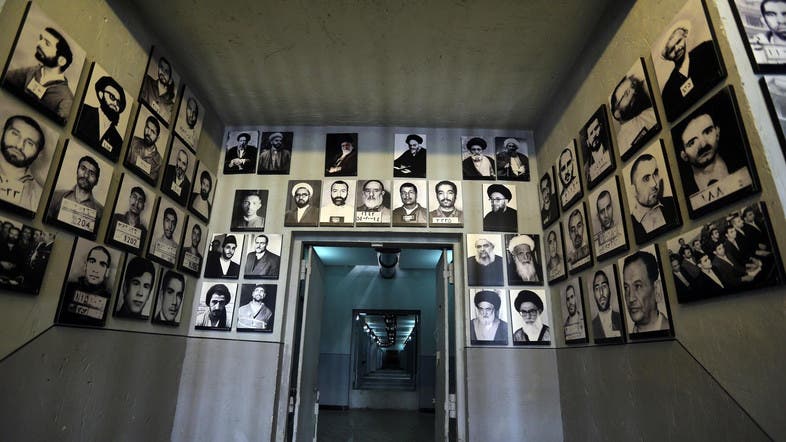
A picture taken on September 2, 2014 in Tehran shows portraits of detainees in “Qasr prison” in Tehran. (AFP)
“Today,
it is still not known exactly how many prisoners were extra-judicially
executed in 1988, although minimum estimates are between 4,000 and 5,
000,” AI report said. “International rights groups estimate as many as
5,000 people were executed, while the Mujahedeen-e-Khalq puts the number
at 30,000,” writes Jon Gambrell of Associated Press.
“The
report identifies seven suspected or confirmed mass grave sites that
have faced destruction between 2003 and 2017. They are located in or
near Behesht Reza cemetery in Mashhad, Khorasan Razavi province; Behesht
Abad cemetery in Ahvaz, Khuzestan province; Vadieh Rahmat cemetery in
Tabriz, East Azerbaijan province; Golestan Javid cemetery in Khavaran;
Tazeh Abad cemetery in Rasht, Gilan province; the Baha’i cemetery in
Qorveh, Kurdistan province; and the grounds of the former premises of
the Revolutionary Court in Sanandaj, Kurdistan province.” Mass graves
have being gradually leveled to escape any possible future
accountability.
“Some who appeared were
asked to identify themselves. Those who responded “mujahedeen” were sent
to their deaths, while others were questioned about their willingness
to “clear minefields for the army of the Islamic Republic,” a 1990
Amnesty report said.
The body called for
an enquiry commission to probe most ruthless officials of the Iranian
regime, many of whom, according to the AI report, are still in office.
It was known among former Iranian political prisoners as the “Death
Commission”.
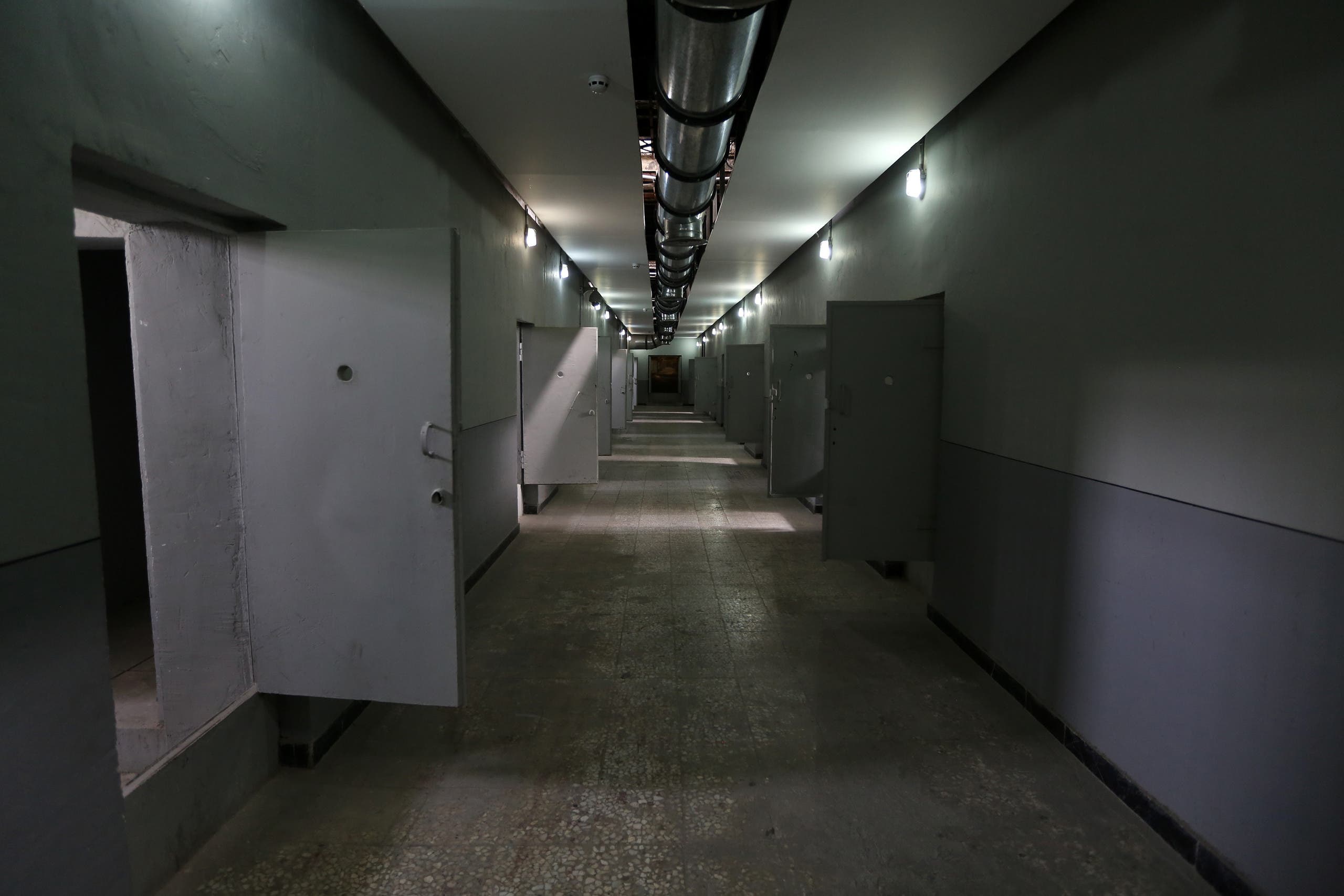 A picture taken on September 2, 2014 in Tehran shows portraits of
detainees in “Qasr prison”, a former prison hosting political prisoners
that was turned into a museum in 2012. (AFP)
A picture taken on September 2, 2014 in Tehran shows portraits of
detainees in “Qasr prison”, a former prison hosting political prisoners
that was turned into a museum in 2012. (AFP)Rewarding the culprit?
The right
group added in its latest report that no Iranian official has been
investigated or brought to justice and some of the alleged perpetrators
continue to hold political office or influential positions in the
judiciary.
Two high profile examples of
AI’s report are Ebrahim Raisi a challenger to Hassan Rouhani in last
year’s presidential election and now the custodian of the wealthiest
Imam Reza Foundation in Mashhad and Mostafa Pour-Mohammadi, Iran’s
Justice Minister in Rouhani’s first cabinet.
He
was then promoted and received an advisory position in Iran’s Judicial
branch. Rouhani on the other hand had the nerve to pick Alireza Avii,
another member of the notorious “Death Commission,” to head the Justice
Ministry in his second cabinet. The commission oversaw the massacre of 30,000 political prisoners in the summer of 1988, mostly members and supporters of the opposition People’s Mojahedin Organization of Iran (PMOI or MEK).
Raisi
and Pour-Mohammadi were two of the four members of the Death Commission
who were tasked to summarily execute political prisoners. Khomeini
reportedly hand wrote a fatwa, a religious decree, authorizing the
Commission’s task. In the summer of 1988, the Commission handed down
30,000 death sentences. The kangaroo courts hardly lasted more than
three minutes on average. Some of the political prisoners who
miraculously survived the slaughter have written or spoken of their
ordeals.
A simple question was asked by
the judges: Do you still believe in Mojahedin? And depending on the
answer, one could end up before a hangman. The gruesome accounts of
survivors, especially female prisoners, often leave the listeners in
shock.
What first shined light on all of
this was an audio tape that was leaked out by Ayatollah Hossein-Ali
Montazeri’s son in August 2016. Montazeri was sacked for his public
objections to mass executions in 1988. He spent the rest of his life
under house arrest and died in 2009.
In
the moving tape, Montazeri can be heard telling a meeting of the “Death
Commission” in 1988 that they are responsible for a crime against
humanity. “The greatest crime committed during the reign of the Islamic
Republic, for which history will condemn us, has been committed by you.
Your names will in the future be etched in the annals of history as
criminals,” he said.
Pour-Mohammadi has
since admitted his role in the “Death Commission” and boasted that he
was proud to “carry out God’s will and he has not lost sleep over what
he did.”
“Most of those extrajudicial
executed were serving lengthy prison sentences, often imposed for their
peaceful dissent, including for activities such as distributing
newspapers and leaflets, taking part in peaceful anti-government
demonstrations, and having real or perceived affiliations with various
political opposition groups. Some had been released several years
earlier and were re-arrested in the weeks leading up to the killings.
Others had already completed their sentences but had not been released
because they refused to make statements of ‘repentance’,” the AI report
said.
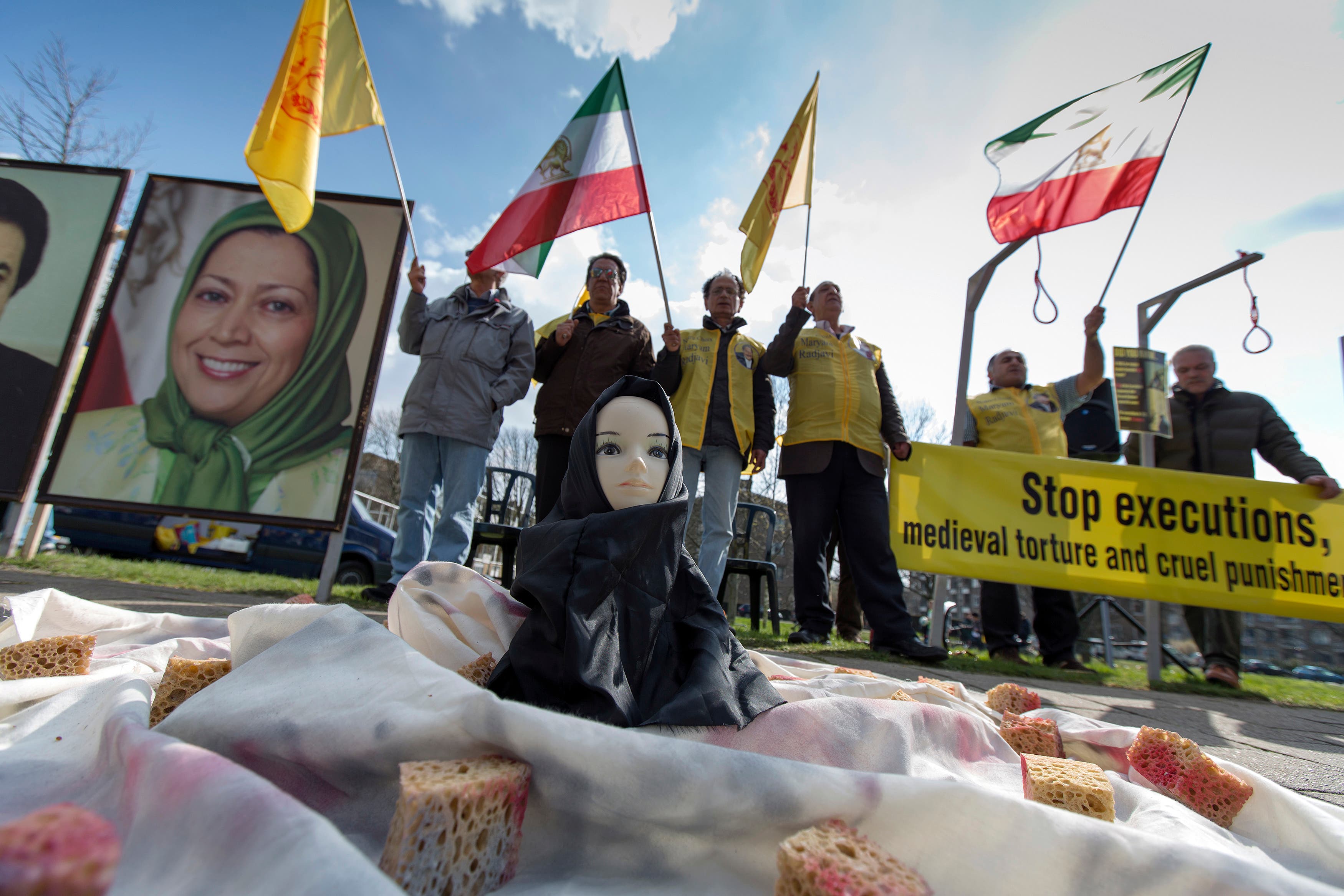 People protest against executions and human rights violations in
Iran on a square near the Nuclear Security Summit in The Hague March 25,
2014. (Reuters)
People protest against executions and human rights violations in
Iran on a square near the Nuclear Security Summit in The Hague March 25,
2014. (Reuters)House of Representatives
The right group is not alone in digging up Iran’s ruling clerics dark past in dealing with its dissidents; the US House of Representatives passed a bill last week condemning human rights violations in Iran including the massacre of political prisoners in 1988.
Ed
Royce, Chairman of the House Foreign Affairs Committee wrote: “The
worst act against the Iranian people was the execution of 30,000
political prisoners in Iran by the regime over the course of four months in 1988. Many of those prisoners had just completed prison sentences before being executed.
There are multiple officials in the Iranian government today that were part of that crime against humanity. Calls for justice
for the victims have continued, and calls for the international
community to step in on behalf of those prisoners and their families.”
The new house bill also condemns hostage-taking tactic among foreign
national and Iranians holding dual citizenship used by the regime since
its inception.
Despite the focus on May 12
deadline for the nuclear deal with Iran – known as Joint Comprehensive
Plan of Action (JCPA) – the Iranian regime continues violation of human
rights at home. It is high time that the world put an end to this
flagrant violation of human rights in Iran and take some concert steps
in that direction.
#prisoners #Executions
#1988Massacre #StopFlogging
#Political prisoner
#Political prisoners #Iran @massacre_67


هیچ نظری موجود نیست:
ارسال یک نظر